
No items found.
Marketing
Your Marketing Is Speaking a Language Your Buyers Don't Understand Yet 😳
And no, the problem is not your creative.
Marlena Sarunac
Posted on
June 23, 2026
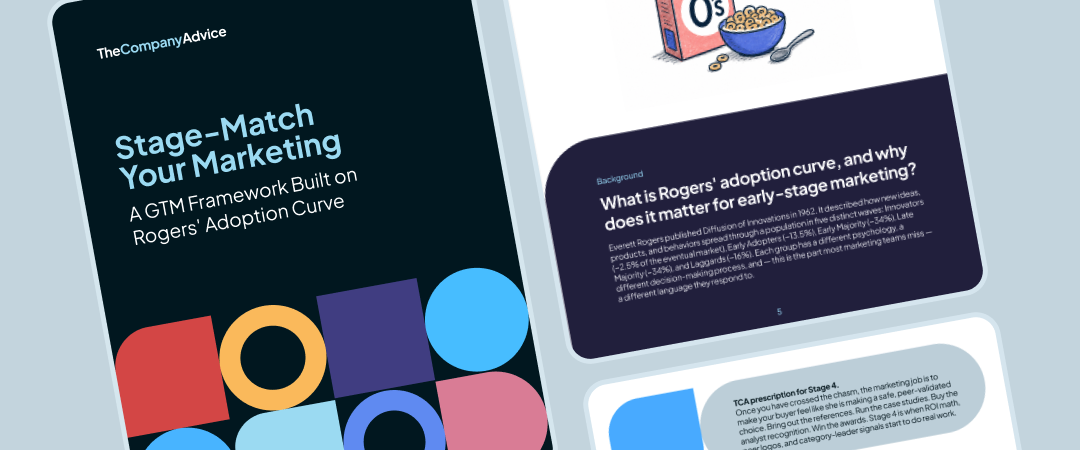

Key Takeaways
In 2008, Brian Chesky and Joe Gebbia were broke, behind on rent, and in possession of a genuinely world-changing idea that absolutely no one was paying attention to.
So they did what any rational startup founder would do: they bought cereal, some cardboard, a hot glue gun, and hand-assembled fake breakfast boxes called Obama O's (The Breakfast of Change) and Cap'n McCain's (A Maverick in Every Bite).
They sold $30,000 worth of novelty cereal to delegates at the Democratic National Convention. This, improbably, is what convinced Paul Graham at Y Combinator to fund Airbnb. Not the pitch deck. Not the TAM slide. The cereal.
Here's what's wild about that story: six years later, the same company launched a global rebrand built around a single word — Belong — that would take a design agency a full year to build, require travel to 13 cities across four continents, and become one of the most celebrated rebrands in modern marketing history.
And then six years after that, Airbnb ran what they called one of the largest advertising campaigns in their history. No stunts, no manifestos. Just real photographs of real homes, submitted by real hosts. The campaign was called Made Possible by Hosts, and it was designed to remind a pandemic-fatigued world that going somewhere — anywhere — might be worth doing again.
Three campaigns. Fifteen years. The same company.
None of them was a creative pivot. None of them was a brand refresh for its own sake. And none of them was an accident.
Here's the thing most marketing teams miss
Chesky and Gebbia weren't being quirky with the cereal. They were being precise. The cereal was the right message for the right buyer at the right moment. So was "Belong Anywhere." So was the photo campaign.
The language that got Airbnb its first users, the language that crossed them into the mainstream, and the language that held a global franchise together in a crisis are three completely different languages — and if you'd swapped any of them, they would have failed.
This is the problem hiding inside a massive percentage of early-stage marketing budgets right now. The creative is polished. The positioning sounds right. The deck is beautiful. And nothing is converting.
It's not because the work is bad. It's because it's written in the wrong language — borrowed from a stage of buyer adoption the company hasn't reached yet, or got stuck in long after it should have moved on.
We see this constantly at The Company Advice, particularly in health tech and insurtech. A founder comes in with a homepage that sounds like a Fortune 500 press release. Phrases like transforming the healthcare experience and a platform built for the modern enterprise. It's polished. It's confident. It is written, with exquisite precision, for a buyer who does not yet exist in their customer base.
Their actual customers are early innovators. People who found them because they personally had the exact problem being solved and couldn't find anyone else fixing it. And those people — thank the heavens — do not want transformation. They want a solved problem, described in plain language, that they can repeat back to a colleague in one sentence.
The mismatch is almost always invisible to the founder, because the language feels more credible, more grown-up, more fundable. The problem is it's speaking to the wrong room.
So we built a framework for it
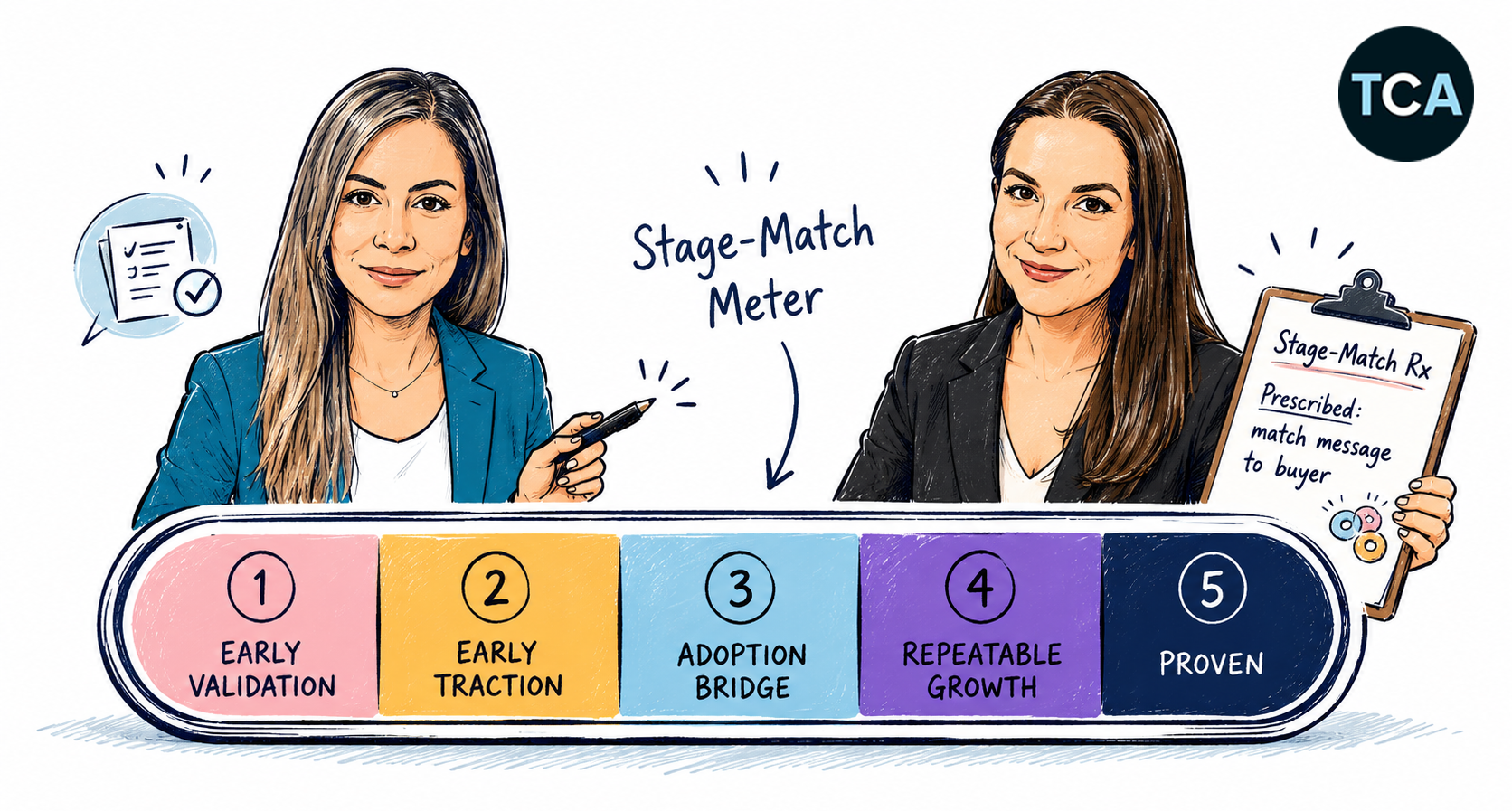
It's called Stage-Match, and it maps Everett Rogers' 1962 adoption curve — Innovators, Early Adopters, Early Majority, Late Majority, Laggards — to the specific marketing language, channel mix, and brand moves that actually work at each stage. It uses Airbnb's 15-year arc as the case study, because it's the cleanest documented public example of stage-matched language we know of.
The core argument is this: the message that earns funding, the message that wins your first ten customers, the message that crosses the chasm into the mainstream, and the message that defends a category leadership position are four different messages. Most pre-Series C founders are using late-stage language on early-stage buyers, and the result is a marketing budget that buys craft without buying conversion.
We trace each of Airbnb's five stages in the paper — from the cereal boxes right through to the moment in 2014 when everything changed. And that moment? It was not obvious. It was not safe. And the data that came out of it was...
Well. That's where we're going to make you download the paper.
The white paper includes
- A full stage-by-stage breakdown of what Airbnb said, who they said it to, and why it worked (and when it stopped working)
- The Stage-Match framework table: language pattern, channel mix, signals you're ready to advance, and the most common mistake at each stage
- The Stage-Match Test — a five-question, 30-minute diagnostic you can run on your own marketing today to figure out which stage you're actually in vs. which stage your language thinks you're in
- TCA prescriptions for each stage, written for pre-Series C founders with real budget constraints
Download the full white paper: Stage-Match Your Marketing, below ⤵️

Download Now
We mapped what your message should actually sound like at each stage. Read the full breakdown in the white paper!
Thank you! Your submission has been received!
Oops! Something went wrong while submitting the form.
Frequently asked questions
01
Why isn't my startup marketing converting even though the copy is well-written?
Well-written copy that's matched to the wrong stage of buyer adoption won't convert — full stop. The most common culprit for pre-Series C companies is using mature-market language (ROI proof points, peer logos, enterprise positioning) while the actual customer base is still made up of innovators who need a specific problem named in language they can repeat to a colleague. The fix isn't better copy. It's copy written for the stage your buyers are actually in.
02
What kind of marketing messaging works for early-stage B2B startups?
At Stages 1–2 (Innovators and Early Adopters), the messaging that wins is almost embarrassingly direct: name the problem in the customer's own language, then name the tribe of people who have it. No transformation language. No platform positioning. Innovators buy solved problems, not visions. Early Adopters buy identity — they want to know what kind of professional they're becoming by choosing your product. The homepage copy should answer: who is this for, and what does that person believe that the rest of their market doesn't?
03
How do I know if my startup is crossing the chasm — and what should my marketing do about it?
The signal that you're approaching the chasm is specific: sales cycles start lengthening, references become decisive, and win rates drop when you don't have a peer logo to show. When you see those signals, the marketing job changes from "sell the future" to "sell the whole product." This is when brand work — the kind most pre-Series C founders postpone — becomes the bridge. The language needs to shift from visionary identity to belonging, safety, and peer validation.
04
When should a health tech or insurtech startup invest in brand work?
Not at pre-PMF — that's too early for full brand investment, and it's a common waste of budget. Pre-PMF, the brand work that matters is a single, specific thing: positioning and homepage copy that names the problem in the customer's own words. Full brand identity work is a chasm-crossing investment, typically appropriate when sales cycles are lengthening and pragmatist buyers are starting to ask for peer references. The mistake The Company Advice sees most often: investing in Stage 4 polish (logos, brand campaigns, enterprise aesthetics) on a Stage 1 or 2 product.
05
How did Airbnb's marketing strategy change as the company grew, and what can B2B founders learn from it?
Airbnb's marketing evolved through five distinct stages, each with different language and a different target buyer. In 2007–2008, it was literal problem description for innovators (an airbed in someone's living room, sold-out conference hotels). By 2009–2013, it shifted to identity language for early adopters ("travel like a local"). In 2014, the "Belong Anywhere" rebrand crossed them into the early majority. By 2016, "Live There" was mainstream brand advertising for pragmatists who needed peer permission. And by 2021, "Made Possible by Hosts" was mature-stage retention. The B2B lesson: each stage required a completely different message — not a refinement of the last one, but a deliberate rewrite for a different buyer psychology.


.png)
